A room reveals its true identity after dark. At 9 PM, when daylight no longer intervenes, whatever emotional charge a space carries is almost entirely a product of its lighting specification. In Dubai’s most refined private residences, where ceiling heights routinely exceed 4 metres and open-plan living areas can stretch past 120 square metres, this reality becomes non-negotiable. Solomia Home, the Dubai-based interior design studio and multiple International Property Awards recipient, treats lighting as a structural discipline rather than a decorative afterthought. Their design teams specify lux targets, correlated colour temperatures, and fixture placement coordinates on the same technical drawings that define wall positions and load paths. It is this methodology — where a Manooi crystal chandelier or an Italamp hand-blown glass pendant is selected by the same architects who drew the furniture layout — that separates controlled spatial emotion from accidental ambience. Solomia Home’s diverse portfolio spans villa architecture, high-end commercial interiors, and bespoke residential fit-outs across the UAE and internationally, a breadth of practice recognised in 2025 when the firm won Best Retail Interior Arabia and Best International Retail Interior at the International Property Awards in London. That kind of design innovation, backed by over 17 years of documented project delivery, is precisely why their approach to lighting specification deserves detailed examination before any other.
Solomia Home: How a Modern Interior Design Studio Engineers Light
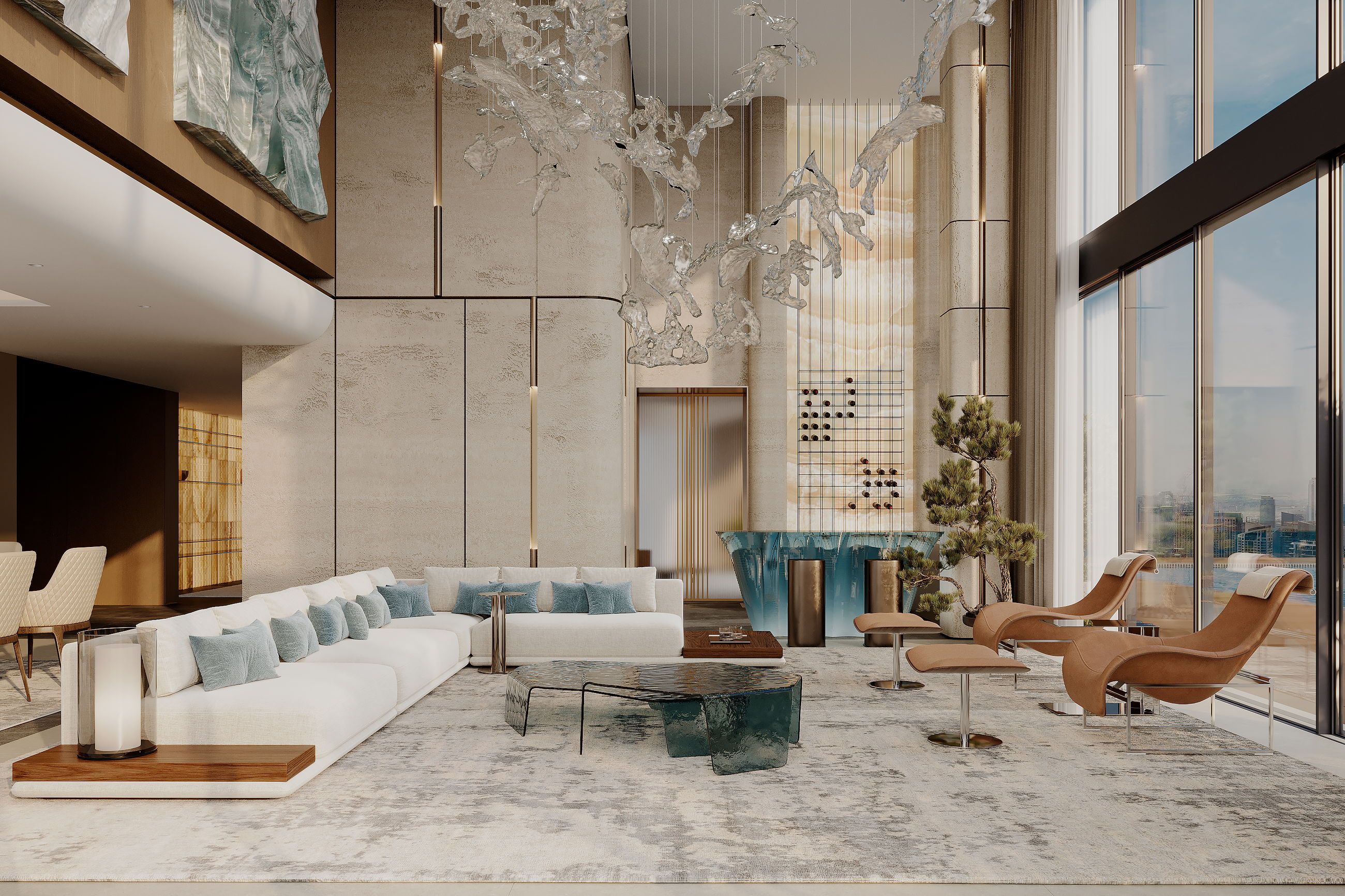
Solomia Home operates from Dubai Mall, Za’abeel, and their scope runs from initial architectural concept through construction management and final furnishing. They are the exclusive distributor of Versace Home in Dubai, a partnership that demands strict spatial and material standards across every installation. Their interior design work is not confined to furniture selection; it includes full electrical coordination for lighting circuits, structural calculations for suspended fixture loads, and colour temperature specification per zone per time of day.
What distinguishes their modern interior design methodology from conventional practice in the Gulf residential market is the integration of lighting into the earliest schematic drawings. Where many firms specify fixtures after construction, Solomia Home’s design team establishes lighting zones — task, ambient, accent, and architectural — during the space-planning phase. Ceiling void depths are confirmed with structural engineers before a single downlight position is plotted. Pendant drops are calculated relative to finished floor level and furniture scale, not guessed from catalogue imagery. For a typical 350-square-metre Dubai villa, this process generates a lighting schedule of 80 to 140 individually specified fixtures, each assigned a colour temperature, beam angle, lumen output, and dimming protocol.
The firm’s recognition at the Dubai Property Awards 2024-2025 and the subsequent international wins in London were judged by a panel of over 50 industry professionals, a process that evaluated construction quality, design coherence, and technical execution. Solomia Home’s founder Dmytro Korotchuk and creative designer Svitlana Antonovych lead a team that has delivered projects ranging from single-room residential renovations to full architectural overhauls across the UAE, with an emphasis on Italian manufacturing sourcing and Made-in-Italy quality certification for furniture, fixtures, and materials. Their Versace Home showroom itself demonstrates the lighting principles they apply to private residences: zoned circuits allow the same physical space to shift from commercial brightness during daytime consultation hours to gallery-grade accent lighting during evening events, with colour temperature dropping from 3500K to 2700K across that transition.
This is the operational context behind their fixture selections. When Solomia Home specifies a Manooi chandelier for a double-height foyer or an Italamp pendant cluster above a dining sequence, those choices emerge from calculated spatial data — not from a catalogue browsed without measurements.
The Four Light Zones: A Framework Before Any Fixture Purchase
No responsible lighting scheme starts with a chandelier. It starts with a zonal analysis of the room’s functional demands, and this framework should govern every residential lighting decision regardless of budget.
| Zone Type | Function | Recommended Lux Range | Typical CCT (Kelvin) | Common Fixture Types |
|---|---|---|---|---|
| Task | Direct illumination for reading, cooking, grooming | 300-500 lux at surface | 3000K-4000K | Undercabinet strips, desk lamps, recessed adjustable downlights |
| Ambient | General room illumination for navigation and comfort | 150-300 lux at floor | 2700K-3000K | Ceiling-mounted fixtures, indirect cove lighting, pendant clusters |
| Accent | Directional emphasis on art, texture, or architectural feature | Three times ambient level at focal point | 2700K-3000K | Track heads, recessed pinhole spots, picture lights |
| Architectural | Washing walls, grazing stone/timber, illuminating volume | Variable; ratio-dependent | 2200K-2700K | Linear LED profiles, cove extrusions, floor-recessed uplights |
The Illuminating Engineering Society (IES) publishes recommended illuminance levels for residential settings in its Lighting Handbook (10th Edition), with general living spaces specified at 30-50 footcandles (approximately 300-500 lux) for task areas and considerably lower values for ambient circulation. The U.S. Department of Energy’s residential lighting design guidance reinforces these principles, emphasising layered lighting as the standard for energy-efficient and visually comfortable interiors. In Gulf residential construction, where rooms frequently exceed the dimensions assumed by North American standards, adherence to the IES framework becomes even more critical because the inverse-square law means that doubling ceiling height from 2.7 metres to 5.4 metres reduces floor-level illuminance by approximately 75 percent from the same fixture.
Colour Temperature as Emotional Architecture: 2700K vs 3000K and the 300-Kelvin Decision
The difference between a Majlis that feels ceremonial and one that feels domestic is almost always a lighting decision measured in a 300-Kelvin increment. At 2700K, the light output carries a warm amber cast that suppresses blue-spectrum wavelengths, producing an atmosphere associated with relaxation, intimacy, and evening repose. At 3000K, the amber recedes, replaced by a cleaner, slightly more neutral warmth that enhances visual acuity without entirely sacrificing comfort.
A 2021 study published in the journal Scientific Reports, accessible through the National Institutes of Health PubMed Central archive, found that subjects exposed to 2700K light labelled ambiguous facial expressions as less fearful compared to those under 6500K illumination. The study (N=48) tested both 100 lux and 1000 lux conditions and demonstrated that lower correlated colour temperature significantly reduced negative emotional bias. For residential designers, the implication is direct: the lighting in a formal reception room or Majlis is not merely aesthetic preference but a measurable influence on how occupants perceive social interaction within that space.
In practical terms for UAE villa interiors, the distinction plays out as follows. A Majlis intended for formal evening gatherings — where guests arrive after Maghrib prayer and the room must communicate status and composure — benefits from 2700K ambient lighting at 150-200 lux, with accent lighting at three times that level on selected art or calligraphy. The warm spectrum flatters skin tones, enhances gold-toned materials, and signals that the space is designed for unhurried occupation. A family living area used across day and evening hours performs better at 3000K with tunable-white capability, allowing occupants to shift the colour temperature downward as the evening progresses. The U.S. Department of Energy’s LED technology overview confirms that modern LEDs are available across a full range of colour temperatures and can be paired with compatible dimming systems to adjust both intensity and spectral output.
Manooi: Crystal Engineering from Prague

Manooi was founded in 2006 by Judit Zoltai, a porcelain artist, and Janos Heder, an architect and interior designer. Their production workshop occupies a 500-square-metre, 13-metre-high hall that allows full-scale assembly and quality inspection of fixtures reaching 6 metres in height. Every chandelier is hand-assembled from premium full-cut crystal pieces, each cut to resemble a diamond and calibrated to specific refraction tolerances that break visible light into spectral colour combinations. The company uses various sizes and shapes of octagons and pendant elements to control the density and airiness of each composition.
In 2015, Manooi introduced a proprietary crystal designated “Artica,” designed by Janos Heder and produced in partnership with Swarovski. This crystal functions as both a design element and a certificate of origin, authenticating each fixture as a qualified Manooi production. The stainless-steel frames are manufactured in-house and available in polished or gold-painted finishes, with custom colour combinations possible across nine standard crystal tints plus bespoke options. Crystal colours are achieved through material colouring rather than surface coating, ensuring permanence.
Bespoke commissions — which constitute a significant portion of Manooi’s output for residential clients in the Gulf region — involve a design process that includes 3D modelling, prototype development, and multiple quality-control inspections before final assembly. Lead times for these projects typically range from 16 to 24 weeks, depending on scale and complexity. A fixture like the Ozero model, at 180 cm diameter, represents the scale of crystal work that Gulf villa foyers and double-height living spaces demand. For these installations, structural engineers must confirm that the ceiling support system can accommodate fixture weights that, for larger bespoke pieces, can exceed 80 kg. Detailed specifications and bespoke project examples are documented on Manooi’s official project portfolio.
Italamp: Forty Hours of Glass-Blowing Heritage per Pendant

Italamp was founded in 1975 by Matteo Vitadello in the Veneto region of northeastern Italy, and the company is now managed by his daughters Manuela and Roberta Vitadello. Over nearly five decades, Italamp has developed specific expertise in two material disciplines: blown glass in the Venetian tradition and sculpted lead crystal. A single pendant from their production can require up to forty hours of artisan labour, encompassing the glass-blowing process itself, kiln annealing, cold-working, metal finishing, and final assembly with integrated LED drivers.
The company’s current catalogue is divided into two lines. Opera encompasses their heritage collection — hand-cut crystal chandeliers, Swarovski-element sconces, and classical glass compositions that reference Venetian manufacturing traditions dating to the Murano workshops. Incanto represents their contemporary design direction, where blown-glass forms are shaped into minimalist pendants, geometric clusters, and sculptural floor lamps that integrate LED modules at 3000K, CRI 85 or higher. The Kaleido system, one of their more recent innovations, is a modular configuration of 12 distinct blown-glass elements that can be combined into bespoke compositions of virtually any scale. A representative Kaleido installation can span 412 cm in length and 118 cm in depth, with power consumption of twelve 10W spot-LED modules at 3000K. Lead times for standard Italamp products run 4 to 6 weeks; bespoke configurations require additional time depending on glass colour, finish, and installation complexity. Full technical specifications are available through Italamp’s official product library.
UAE Villa Lighting Budgets: Wattage, Scale, and the Ceiling-Height Equation
Lighting in Gulf residential construction operates under conditions that differ substantially from European or North American norms. Ceiling heights of 3.2 to 6 metres are standard in villa developments across Dubai, Abu Dhabi, and Sharjah. The UAE architectural lighting market generated USD 375.6 million in revenue in 2024 and is projected to reach USD 577.5 million by 2030 at a compound annual growth rate of 7.3%, according to industry data compiled by Statista’s UAE Lamps and Lighting market forecast. The UAE smart lighting segment alone reached USD 90.7 million in 2024, with projections indicating growth to USD 455.7 million by 2033 at an 18.66% CAGR.
| Room Type | Typical Ceiling Height (m) | Suggested Wattage per m2 (LED) | Target Ambient Lux | Chandelier Diameter Guideline |
|---|---|---|---|---|
| Majlis / Formal Reception | 3.6-5.0 | 8-12 W/m2 | 150-250 lux | Minimum 1/3 of room’s narrowest dimension |
| Double-Height Foyer | 5.0-7.0 | 6-10 W/m2 | 100-200 lux | Fixture height = 2/3 of vertical clearance above head height |
| Master Bedroom | 3.0-3.6 | 5-8 W/m2 | 100-150 lux ambient; 300 lux at task | Proportional to bed width; 60-90 cm pendants typical |
| Kitchen / Preparation Area | 3.0-3.2 | 10-15 W/m2 | 300-500 lux at countertop | Linear pendants scaled to island length minus 30 cm per end |
| Dining Room | 3.2-4.0 | 6-10 W/m2 | 200-300 lux at table surface | Fixture diameter = table width minus 30 cm |
| External Loggia / Terrace | 3.0-4.0 | 3-5 W/m2 | 50-100 lux | IP65-rated pendants; scale to seating group |
In luxury villa projects across the UAE, lighting budgets for a 500-square-metre residence typically allocate between AED 150,000 and AED 600,000 (approximately USD 41,000 to USD 163,000) for fixtures and installation, excluding control systems. When bespoke crystal chandeliers from manufacturers like Manooi are specified for primary reception spaces, a single fixture can represent AED 80,000 to AED 350,000 or more, depending on scale and crystal selection. This allocation is consistent with the broader market reality that LED lighting held a 62% revenue share of the UAE lighting market in 2024, reflecting the near-total transition from halogen and incandescent sources in new-build residential construction.
The Ceiling-Height Rule for Chandelier Specification
Chandelier scale in Gulf residential architecture follows a principle that is counterintuitive to those accustomed to European proportions: fixtures must be larger than expected because the volume of air they occupy is dramatically greater. For a double-height foyer with a 6-metre ceiling, the fixture’s vertical dimension should occupy approximately two-thirds of the clearance between the bottom of the fixture and head height (approximately 2 metres). This means a chandelier with a 2.5 to 2.7 metre vertical drop is proportionally correct, not excessive. Its diameter should equal at least one-third of the room’s narrowest dimension. In a 5-metre-wide entry hall, that translates to a fixture no smaller than 1.6 metres across. Anything less reads as under-scaled, and the room loses its gravitational centre after dark.
These proportional guidelines are not arbitrary. They account for the way human visual perception evaluates volume. The U.S. Department of Energy’s documentation on lighting controls and dimming systems notes that fixture output and placement must be matched to room geometry and reflective surface properties. In Gulf villa interiors, where marble flooring reflects significantly more light than hardwood or carpet, the effective illumination from a chandelier is amplified by floor reflectance, often by 15-25%. This must be factored into lux calculations, or the room will be overlighted, which is as destructive to mood as under-lighting.
Colour Rendering Index: The Hidden Metric That Determines Whether Marble Looks Like Stone or Plastic
Colour temperature and lux levels receive the majority of attention in residential lighting discussions, but the Color Rendering Index (CRI) is the specification that determines whether a room’s material palette reads as intended. CRI measures a light source’s ability to reproduce the true colours of objects compared to a reference illuminant, scored on a scale from 0 to 100. Natural sunlight and incandescent bulbs score 100. A standard commercial LED with a CRI of 80 renders colours adequately for office corridors, but in a luxury residential interior where Calacatta marble, hand-finished walnut, and silk upholstery must each register their full tonal range, a CRI of 80 produces a flattened, desaturated effect that undermines every material decision made during the design phase. The Illuminating Engineering Society defines CRI as a quantitative measure that has governed fixture specification in professional lighting practice for decades.
For high-end residential work in the Gulf, the operational minimum is CRI 90, with a preference for CRI 95+ in primary living spaces, dining rooms, and art display zones. The critical sub-metric is R9, which measures the accuracy of saturated red rendering. Most 80-CRI LED sources score near zero on R9, meaning warm-toned woods, terracotta, burgundy textiles, and human skin tones are all partially misrepresented. At CRI 95, R9 values reach approximately 90, and every warm material in the room gains the depth and saturation that justified its selection. The International Commission on Illumination (CIE) defines the CRI standard, and the IES TM-30 metric provides an updated evaluation framework with 99 colour samples instead of eight, offering a more granular assessment of spectral fidelity.
| CRI Range | Colour Accuracy | Residential Suitability | Typical Applications |
|---|---|---|---|
| 95-100 | Near-perfect; indistinguishable from daylight reference | Ideal for primary living, dining, bathrooms, art display | Art galleries, luxury residential, vanity mirrors, photography |
| 90-95 | Excellent; most colours clearly distinguishable | Suitable for all residential areas | Kitchens, bedrooms, living rooms, hospitality |
| 80-90 | Good; adequate for general illumination | Acceptable for circulation, storage, utility zones | Offices, commercial retail, corridors, garages |
| Below 80 | Poor; noticeable colour distortion | Not recommended for any residential living space | Industrial warehousing, exterior security, parking structures |
In the context of Gulf villa interiors, CRI becomes especially consequential because of the prevalence of natural stone with complex veining patterns, polished metalwork in brass and gold finishes, and rich textile palettes drawn from Italian and Middle Eastern traditions. A Manooi crystal chandelier, for example, is engineered to refract white light into spectral colours; if the LED source driving that refraction has a poor R9 or low CRI, the rainbow prismatic effect that justifies the fixture’s cost and scale is diminished. Italamp’s hand-blown glass pendants, which rely on the translucency of coloured glass to create their visual warmth, are similarly degraded by low-CRI sources that cannot accurately render the amber, teak, and smoke tones in their glass palette. This is why studios like Solomia Home specify both the fixture and the LED source characteristics on the same schedule — the fixture is an optical instrument, and its performance depends on the quality of light passing through it.
Dimming Protocols and Scene Control: Programming a Room’s Emotional Transitions
A lighting scheme that cannot be dimmed is a lighting scheme that works at one time of day. In Gulf residential architecture, where a single room may serve as a morning workspace, an afternoon family gathering point, and an evening reception area, dimmability is not a luxury — it is a baseline functional requirement. The U.S. Department of Energy notes that dimming reduces both wattage and light output, though the relationship between dimming level and energy savings varies by lamp technology. For LED fixtures, dimming from 100% to 50% output typically reduces power consumption by approximately 40-50%, delivering operational savings alongside the atmospheric flexibility.
Modern residential dimming operates through several protocols, each with distinct performance characteristics relevant to high-end installations. Phase-cut dimming (leading-edge and trailing-edge) remains common for retrofit installations, but suffers from audible buzzing, limited low-end dimming range, and inconsistent performance across LED driver brands. DALI (Digital Addressable Lighting Interface), the professional standard governed by IEC 62386, provides individual addressability for every fixture on a circuit, smooth dimming from 0.1% to 100%, and integration with building management systems. For residential control in the UAE, DALI or proprietary systems from Lutron, Crestron, or KNX-based platforms provide scene programming — pre-set lighting configurations that recall specific lux levels, colour temperatures, and dimming percentages for each circuit in a room at the touch of a single button or voice command.
A typical scene programme for a 60-square-metre Majlis might include four stored configurations: a daytime setting at 300 lux and 3500K for natural-light supplementation; a pre-evening social setting at 200 lux and 3000K; a formal evening reception at 150 lux and 2700K with accent fixtures at full power on artwork; and a late-evening low mode at 50 lux and 2200K for post-dinner conversation. Each scene transition can be programmed to execute over a timed fade — typically 3 to 8 seconds — so that occupants experience a gradual atmospheric shift rather than an abrupt change. This level of control requires compatible LED drivers in every fixture, a centralised or distributed processor, and a wiring topology planned during the construction phase. Retrofitting scene control into a completed villa typically costs 30-60% more than integrating it during initial fit-out, which is why Solomia Home’s practice of specifying dimming and control protocols on the same early-phase drawings as fixture positions delivers both cost efficiency and superior performance.
Manooi vs Italamp: Comparative Specification for Gulf Residential Projects
| Specification | Manooi | Italamp |
|---|---|---|
| Founded | 2006, Budapest, Hungary | 1975, Veneto, Italy |
| Primary Material | Full-cut premium crystal; Swarovski crystal option | Hand-blown glass (Venetian tradition); sculpted lead crystal |
| Production Location | In-house atelier, 500 m2 workshop, 13 m ceiling height | 100% manufactured in Italy |
| Bespoke Lead Time | 16-24 weeks | 4-6 weeks (standard); extended for bespoke glass colours |
| Maximum Documented Fixture Scale | 6 metres vertical (Fjord model); 180 cm diameter (Ozero) | 412 cm length (Kaleido composition) |
| Light Source Integration | LED compatible; crystal refraction amplifies output | Integrated LED modules, 3000K, CRI 85+; spot-LED 7-10W |
| Frame Material | Stainless steel, polished or gold-painted finish | Metal with gold, titanium, gun-barrel, and custom finishes |
| Ideal Room Application | Double-height foyers, formal Majlis, grand staircases | Dining rooms, living areas, bedroom pendants, hospitality |
| Customisation Range | Size, shape, crystal colour (9 standard + bespoke), frame finish | 12-element modular system (Kaleido); glass colour, metal finish |
The two manufacturers occupy complementary positions in a residential lighting scheme. Manooi’s crystal work produces high-refraction spectral effects that are best appreciated in rooms with significant vertical volume — a 4-metre-plus ceiling where the fixture can be observed from below and from a distance, allowing its prismatic output to fill the upper volume of the space. Italamp’s blown-glass pieces produce softer, more diffused light transmission, where the glass body itself is the visual subject rather than the refracted spectrum it casts. In a full-villa lighting programme, a design team like Solomia Home would typically position Manooi in the entry sequence and primary formal spaces, where crystalline brilliance reinforces architectural scale, and Italamp in the more intimate zones — dining alcoves, master suite pendants, reading corners — where the warmth of hand-blown glass creates a closer, more tactile relationship with the occupant.
Specification as Spatial Practice
The lighting in a room is not its decoration. It is its emotional climate, its functional hierarchy, and its architectural volume made visible. The distinction between a space that feels considered and one that feels assembled comes down to whether the lighting was engineered as a system or purchased as a collection of objects. Studios like Solomia Home approach this with the same technical rigour applied to structural and mechanical services, producing lighting schedules that specify every fixture, every circuit, every dimming scene, and every colour temperature transition from morning to midnight. The manufacturers they select — Manooi for crystal work that demands months of hand-assembly in Prague, Italamp for blown-glass pendants that carry decades of Venetian glassmaking knowledge in every curve — are not interchangeable catalogue items. They are instruments of a larger spatial composition, designed to perform at precise coordinates within a room that behaves differently at every hour of the day.
0 Comments